From Esther Brenner,

Inspiring
“Project IKARUS” by Liliana Barros at the Origen Festival
In the dance theatre production presented as part of the festival’s winter programme, the Portuguese-born choreographer brings together a fascinatingly detailed movement language into an intense and cohesive whole.
LESLIE KRUMWIEDE
RIOM, 23/02/2026
Exploring states of being
As every year, the winter programme includes a dance theatre premiere. This year, Liliana Barros was secured as choreographer. The Portuguese artist, based in Germany, created Project IKARUS within four weeks on site in Riom, together with Izzac Carroll, Julien Guibourg, Romane Ruggiero, and Davide Sione. The work premiered last week in the Clavadeira. With these freelance artists, she has found strong performers who stand out through their individuality.
Project IKARUS is by no means a retelling of the well-known myth, but rather an exploration of its states of being—and thus also of the dynamics that psychology refers to as the “Icarus complex.” Longing for ascent, encounters with limits, failure—all resonate here in abstract form.
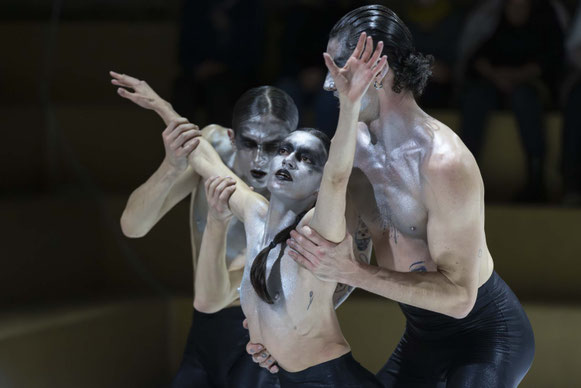
The four performers wear shiny black trousers; their faces and upper bodies are painted silver, with eyes and lips darkly outlined (costumes and set design by Felicia Riegel). Their facial expressions remain mask-like throughout the entire piece.
At the beginning, Romane Ruggiero alone walks the square stage space; Julien Guibourg joins him, followed by Izzac Carroll and Davide Sione. All four move almost mechanically, close together yet without touching, as a unit resembling a geometric block of four that constantly reconfigures itself. It suggests a moving Rubik’s Cube in which, timed to electronic sounds, new (body) patterns continuously emerge as if guided by an invisible hand.
The burden of wings
The structure dissolves. The four test out directions with sudden agitation, yet remain in flow. Speed and restlessness precede the central solo of the piece. In the corners of the room, chains are released from the wooden audience tiers that hold a metal structure suspended above the stage. As it descends, it becomes clear: they are wings, into which Izzac Carroll slips.
Almost bewildered, initially crouching, he seems to sense what task they impose on him. Are they a burden, do they offer a hiding place, or do they—despite their weight—enable freedom? Yet even standing, he does not take off. The metal wings prove to be oppressive restraints, which he ultimately sheds.
A fascinating passage, largely performed on the floor, reveals an almost unbelievable variety of movement as the four performers connect with the white surface in their own distinctive ways, detach from it, and are drawn back again. Acrobatic, sometimes almost amphibian-like, their attempts to leave the ground and move toward something new are striking. The precise yet supple execution they demonstrate is impressive.
Afterwards, the lighting brightens (lighting: Anna Beer), and the four come together in perhaps the most harmonious section in terms of atmosphere. Supported by the spherical quality of the music, the movement language unfolds an almost sculptural effect before the performers, linked in a chain, leave the space—toward what are they striving?
Not easily consumable
Project IKARUS is an intense work that is not easily consumed. Thanks to the immediate proximity offered by the intimate performance space, the richness of detail in Liliana Barros’s work can be especially appreciated.
https://www.tanznetz.de/de/article/2026/project-ikarus-von-lilana-barros-beim-origen-festival
Critically viewed: dance piece “Matriarchs” at the Pavillon in Hanover
What female power is capable of
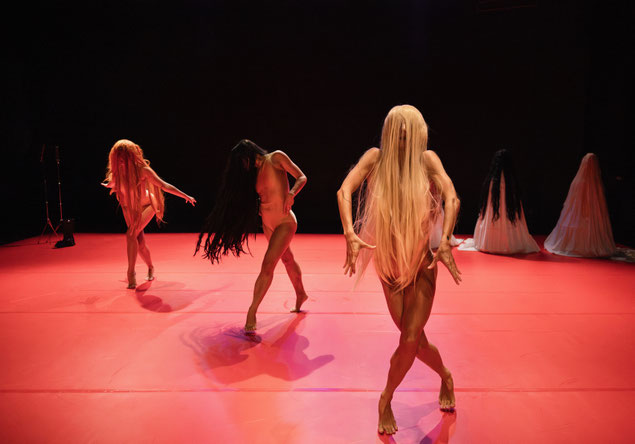
For a long time, they are faceless, they are bodies and hair; hair that hides their faces, that coils around their limbs like seaweed, like flowing curtains, proud manes, protective fur. Several unsettling minutes pass in Liliana Barros’ “Matriarchs” before the three dancers direct their gaze through their red, blonde, or black long-haired wigs toward the audience, revealing themselves as human beings.
Slowly, Clémentine Herveux, Keren Leiman, and Anastasia Senikova peel themselves out of conical dresses, leaving them behind at the back of the stage like shells, like useless game pieces. Only gradually do they seem to discover their bodies, stroking and gliding across the red dance floor, twisting their legs and hands, twitching and sliding, getting in each other’s way. Sitting one behind the other, the dancers briefly appear as a single body, with legs where arms would anatomically be. Then they become hair-beings, whose limbs jut awkwardly and elegantly in all directions.
The dancers seem to have stumbled unknowingly into this world, which they gradually claim for themselves. Groping and searching, they increasingly lift off the floor. They straighten up and experiment with gestures and poses. What begins as tentative headbanging turns into furious whipping of the hair manes, and lovingly braided strands transform into leashes, with one dancer leading the other two across the stage. A tableau that speaks of power and submission.
“Matriarchs” is the title of the latest work by Portuguese choreographer Liliana Barros, which premiered at the Kulturzentrum Pavillon in Hanover. It is an associative evening exploring femininity and power: sometimes the dancers, clad in flesh-colored bodysuits, use their tufts of hair to cover each other’s shame and breasts; sometimes they glide gracefully into a Pietà; sometimes they form a protective nest from their wigs. At other times, they perform ritualized everyday tasks or stride across the stage in a proud, commanding pose.
With highly professional dancers who exploit the full spectrum between ballet and modern dance with great precision, and with symbolic tableaux, Barros creates a compelling, lingering evening that tells of myths, legends, and empowerment, but also of power, helplessness, and loss of control. And it raises, almost incidentally, the unsettling question of what (female) power is capable of.
Katrin Ullmann
12.11.2024
Finding Love
The Hanover State Ballet with “You Are So Beautiful”
RENATE KILLMANN
HANNOVER, 06/02/2024
(...) In the current production “You Are So Beautiful”, three distinct female choreographic voices can be experienced: first up is the Portugal-born, Germany-based Liliana Barros with “Archium”. The title (Archive) refers to something that connects all living beings – from the smallest organism to human beings – through a central hereditary information. Liliana Barros’ aim is to focus on this connective element.
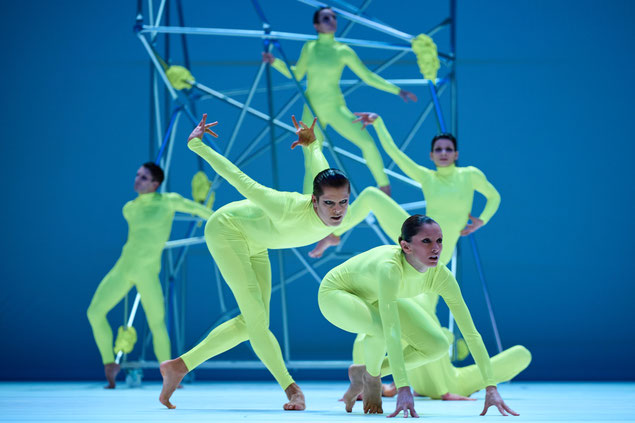
On the stage, enclosed by three enormous opera foils, there is a metallic object that the choreographer interprets as an ancient DNA structure of humanity. On and around this framework, the company moves like a living group, beings caught between human and animal. Their neon-green unitards, combined with phosphorescent lighting effects, create a futuristic atmosphere (the impressive lighting is by Tanja Rühl).
Very slowly, they begin to move: crawling, creeping, twitching, developing a fascinating dance that emerges from a combination of archaic, animalistic, and choreographic motifs. This is set to an impressive electronic sound collage by Martin Mitterstieler, created during the rehearsal process and making its premiere here alongside the choreography. The audience is drawn into a collective, mysterious dance of great intensity. A captivating tableau emerges, evoking a kind of swarm intelligence that ensures the survival of our species. A highly artificial, yet very successful project! (...)
Photo: Carlos Quezada©
https://www.tanznetz.de/de/article/2024/das-staatsballett-hannover-mit-du-bist-so-schoen
WELTEXPRESSO
Peculiar Dream Images
Two Contemporary Variations of “Sleeping Beauty”
von Hanswerner Kruse
On the snow-white stage, a glossy black figure writhes out of a silvery container. It twists, coils, bends, and stalks around in bizarre movements to industrial sounds or contemporary music, only to be finally dragged off the ramp by a huge white-robed figure holding a baby. Gradually, more and more radiant white dancers appear, performing insane acrobatic movements. They resemble rubber-like humans with fixed doll eyes, who after a while futilely attempt to move in sync or approach one another.
Strange dreamlike images emerge—scenarios never before seen in dance theater. These alone make the visit to this double-bill worth it. With other diverse visual tableaux, Portuguese choreographer Liliana Barros takes us through foreign, unreal worlds in “100 Years 100 Hearts”. The seven scenes reference symbols from the once wild fairy tale, which was heavily tamed over time. Unbridled, even dark undercurrents of the story are brought to the surface again by the company.
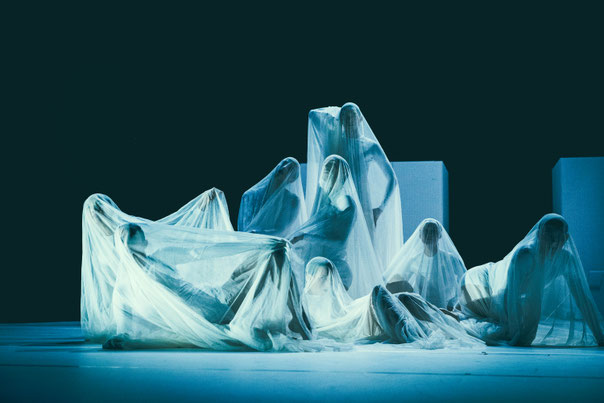
But there are also gentle images: twins swaying back and forth bound together by cords, human sculptures draped in concealing cloths. The dancers paraphrase unspeakable events with their bodies. “Nevertheless, I remain abstract, visual, atmospheric, intuitive, archaic in my creation—to open up space for associations,” says the choreographer.
Foto: © Sylwester Pawliczek
https://weltexpresso.de/index.php/kulturbetrieb/26903-eigenartige-traumbilder
WAZ
Dance Company Enthralls
In the Musiktheater im Revier, “Adam & Eve” explore a futuristic world beyond humanity. The play with clichés meets with unanimous applause.
von Elisabeth Höving
Creeping on all fours, strange insect-like creatures move across the floor. With outstretched arms and legs, they cautiously explore the dark space. End-of-the-world atmosphere prevails in the Kleines Haus of the Musiktheater im Revier: Gelsenkirchen participated in the Ruhrbühnen Festival “Zehn X Freiheit” with the three-part production “Adam & Eve”, which was met with unanimous applause.
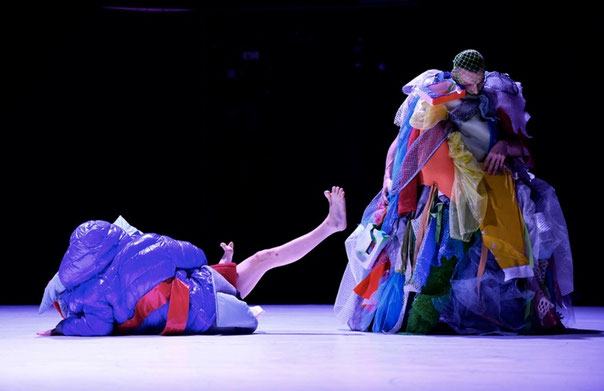
Portuguese choreographer Liliana Barros and her Israeli colleague Roy Assaf explore a world beyond paradise with the athletically trained dancers of the MiR Dance Company. This is particularly striking in Barros’ prologue, “PANORAMA”. The stage—empty, dark, with open doors—serves as a projection surface for a place abandoned by humans, which lost, animal-like beings cautiously reclaim, testing it with their futuristic neon bodysuits.
The only sad reminder of humanity is the colorful piles of plastic waste, with which the post-human world playfully interacts.
The costumes, also designed by the choreographer, provide splashes of color in an otherwise deserted world. The dancers wear colored nets over their faces as they initially move animalistically—like an elegant predator (Eunji Yang slinks impressively along the edge of the stage)—gliding alone across the floor and creating a new universe to the electronically threatening music of Alva Noto. “PANORAMA” is a magical, poetic, and highly captivating excursion.
01.11.2021
photo: Bettina Stoess
Braunschweigischer Zeitung
Saturday, 2. October 2021
Bodies from Another Time
“Techno Fauna” asks how humans move in a dark future.
From Lukas Dörfler
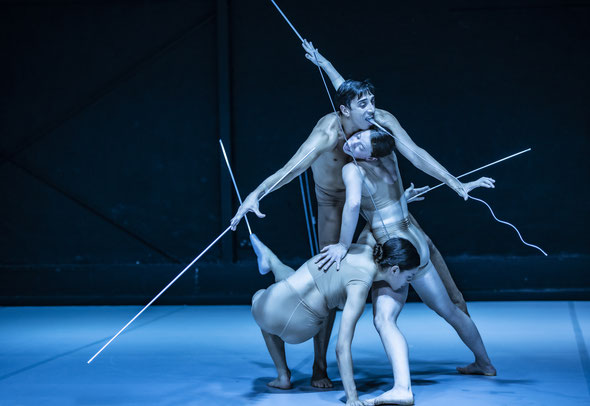
How will we move in the future, once humanity has evolved? A white dance floor, three black cubes from which metal rods grow like futuristic plants, two dancers—Amie Blaire-Chartier and Laura Cornejo—one dancer, Cristian Cucco, and beats and ethereal sounds by Martin Mitterstieler—this is all Liliana Barros needs to explore these questions in her new dance piece “Techno Fauna”. It premiered on Thursday at the LOT Theater in Braunschweig.
The stage design resembles a strange, barren planet. The dancers crouch in front of their metallic plants, casting a long gaze toward the audience. But what does their gaze convey? Are they curious about the intruders, do they even notice us? Are they thoughtful, or simply emotionless? The same gaze is exchanged among themselves when they meet briefly at center stage. They slump to the floor.
Deep beats begin, and the dancers start to move, contort—extremely slowly and with extreme control—then gradually increase in speed. Their movements sometimes seem mechanical, sometimes fluid, yet far removed from anything human. They most resemble beings from another time or another planet—perfectly in tune with the stage design.
Everything appears perfectly choreographed. Even when dancing separately, they know exactly what the others are doing. It feels like watching a ritual, where each has its place, impressively eerie, yet part of a “religion” too complex for the human mind to comprehend.
When they come together, they appear as a single entity, at times like a tree being shaken by winds whose intensity is alien to us on Earth. But this unity is short-lived. Soon they dance against one another, beginning to modify their bodies. The metal rods transform into body parts—extensions of arms and legs, sprouting from their mouths. At first, they experiment with these new “limbs” curiously, but soon the question arises: who is controlling whom—the dancers or their modified bodies? The movements grow wilder and wilder, and fear arises that they might injure themselves—until they free themselves from the rods.
Barros does not provide a single answer to the question of how the human of the future will move. Instead, she presents various scenarios to provoke thought. It would also be interesting to consider why humans have become this way, and how it might still be prevented. One thing is certain after “Techno Fauna”: this future will not be pleasant.
photo: Bettina Stoess
Frankfurter Allgemeine Zeitung

25.02.2020, Nr. 47, S. 34
Attention
Two Solo Choreographies by Liliana Barros
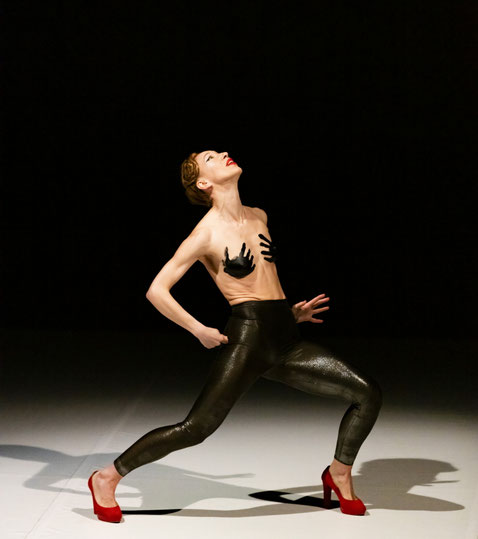
FRANKFURT. In the darkness on stage, all that can initially be heard is excited clattering. As soon as the light appears, it clicks from the speakers, while the stage itself is silent: there stands, bent backward, a flamboyant woman in pumps, bright red like her heavily made-up lips. Metallic shiny leggings, bare skin above, two black hands pressed onto her breasts as if glued there. This bundle of energy will never lose its grotesque tension. While the repetitive flood of sounds from the dictaphone occasionally hints at tango rhythms, the stage creature—embodied by Liliana Barros, who also choreographed the breathtaking Nervure—hungers for more, for something; whether relief or further arousal is impossible to discern. She bends and arches, jerks, strikes, sinks, pulls, rotates, opens her eyes wide, her mouth, stuffs a hand inside, stretches her arms downward and waves them as if trying to shake every bone from her body.
Whether viewed from the front, in profile, or from behind, this sometimes doll-like, stubborn woman—a Pavlova nightmare—is concerned with appearance: how she presents herself before the eyes of the equally hungry mass of real or imagined spectators. She fans with her forearms, waves in an exaggerated manner, as if to boost applause or to catch her breath. Here, the two are indistinguishable. Such hyperactive gestures recall choreographies by Marco Goecke, the resistant, asymmetric postures evoke Marie Chouinard. The Portuguese Barros has danced in works by these and many other artists, including a long tenure in Marguerite Donlon’s ballet in Saarbrücken.
Today, the award-winning dancer choreographs for operas and dance companies, most recently Gaia in Mannheim, which seemed like the embodied dream of her own aesthetic celebrating the bent and contorted—imaginative, wonderful, with only minor dramaturgical weaknesses over longer stretches. Nervure premiered in 2017, won several awards, and was performed last year in the evening Solocoreografico at the Gallus Theater. This time it is paired with Pantera from 2018, danced by the less exuberant Sara Angius. She is dressed in yellow knitwear with a stocking over her head. Referencing the panther from Rilke’s poem, she mostly traces the edge of the white dance floor, her gaze outward, only turning toward the audience at the very end. She drags a stiff leg along. Limps. Or tiptoes on feet, knees, and bottom, rolls across the floor, crouches, lies down, crawls. Vibrates.
The orchestral music, processed by Martin Mitterstieler, together with Rachmaninov’s soprano “Vocalise,” seems to drive and press the animal-human figure, as if the dancer is attempting the immense feeling that the singer achieves, only to fail again and again. This remarkable guest performance is made possible thanks to the new dance curator at the Gallus Theater.
MELANIE SUCHY
photo: Maciej Rusinek
Darmstädter Echo Fern
Choreographer Liliana Barros Fascinates at Mannheim Ballet
However, the fascinating opening is provided by the Portuguese choreographer Liliana Barros with her utterly astonishing work “Gaia.”
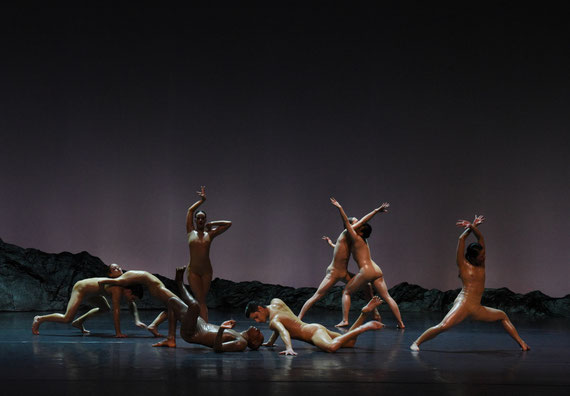
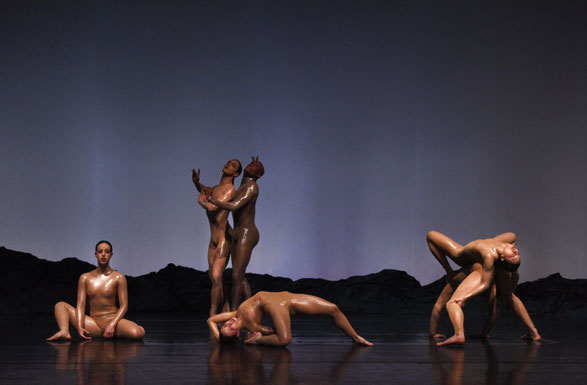
The title refers to the Greek primordial Earth goddess, and the piece presents creation as a continuous process of transformation. At the beginning, the dancers lie in full-body condoms like
mannequins in a wide stage landscape, with a rocky ridge in the background. Then, to Martin Mitterstieler’s abrasive, crackling, pulsating sounds, the first signs of life stir. The way the ten
dancers move in an amoebic, salamander-like, crab-like fashion, twisting and writhing on the floor, is breathtakingly bizarre. Far removed from the classical verticality of ballet, this
Darwinian gymnastics of species unfolds. Over the course of thirty minutes, the wriggling and crawling forms rise, group together, and form ensembles, yet Barros only brushes against humanity and
hints at something beyond.
Individuals come together, form sculptural formations, synchronize their movements, are drawn into a swarm, pulled back, and scattered. In this creation story of species lies the raw material from which dance dreams are made. “Gaia”transports the audience to a seemingly unknown world that, paradoxically, feels surreal yet very familiar.
Theater trips like this are not offered every day. For that reason alone, the journey to Mannheim is well worth it.
Von Erschienen am 27.05.2019
© Christian Kleiner
https://www.tanznetz.de/blog/29296/her-mit-der-zukunft
Tanznetz.de
Mannheim
BRING ON THE FUTURE!
Choreographies by Liliana Barros and Stephan Thoss in the New Mannheim Dance Evening
Community as the Future, Critique of the Established Art World – Mannheim’s Dance Director Presents a Varied Evening
Liliana Barros has left little of Mother Earth in her choreography named after the Greek mother goddess, “Gaia.” Even the jagged black rock that frames the stage at the Schauspielhaus of the National Theater seems strangely powerless. In this equally unreal and inhospitable scenery, shaped only by lighting that alternates between magical and threatening, ten aliens search for their way into the future. The Portuguese choreographer, who also designed the stage and costumes herself, opened the two-part Mannheim dance evening “Evolution” with this premiere.
Ten aliens from a distant future—dressed in intricate, skin-tight, body-revealing full-body costumes with striking body-shaping effects—explore new movement patterns. From archaic contortions to futuristic poses, a firework of original movement ideas emerges. From the individual movement vocabulary of each dancer, a shared group language gradually develops. Threats from the outside—emotionally driven by an effective sound design from Martin Mitterstieler—force these beings from the future into a saving community; ballet movement vocabulary naturally emerges as a common denominator. In acrobatic, aesthetically highly effective tableaux, the original and fascinating vision of the future concludes, offering points of association in every direction.
With the invitation of Liliana Barros—well known in Saarbrücken but otherwise still somewhat of an insider tip—Mannheim’s dance director once again demonstrated his keen eye and absolute openness in selecting talented colleagues from the choreography field. The Mannheim audience agreed: cheers for “Gaia”, bravos for the choreographer.
Published on 25.05.2019, von Isabelle von Neumann-Cosel

Bizarre, comical, spirited, and technically refined: the choreographies “Nervure” and “Pantera” by Liliana Barros are now showing at Commedia Futura in the Eisfabrik in Hanover.
(...) Angius always seems ready to leap, yet invisible barriers make expansive movements impossible. Her energy is confined to quick, intricately nested sequences of steps.
Here too, the idiosyncratic aesthetic of her movement language is captivating. (...)

Braunschweig
Fantastic Journey into a Fox’s Head
“Strong, these colors: turquoise for the stage, strips of foil hanging from the walls. Bright yellow for the huge fox head, pink for the puppet’s suit, slumped and lifeless, leaning against the head on the floor. As if under electric shocks, the puppet now comes to life: a hand rises here, a foot twitches there, fingers wiggle, eyelashes flutter. […] Liliana Barros unfolds a whole spectrum of emotions in the dance around the plush toy: longing and tenderness, happy triumph, playful joy… […]
Liliana Barros dances the many facets of her character with exquisitely sensitive devotion, particularly brilliant in the puppet’s twitching awakening. Each of her movements springs from an inner force field and pulses through her body to the last fiber and fingertip. Her choreography is varied and expressive; the action on stage is imaginative and gripping. […] Both young and older audience members were captivated until the very end. Frenzied applause.”

Luxembourg
The Group Rather than the Individual
“Konjetzky _Barros,” New Choreography in Saarbrücken
“My Name is Legion”
Liliana Barros takes up a quotation from the New Testament referring to a man possessed by demons (Legion). He tries to be one while he is many. For Barros, this is a metaphor for current
population movements, whether refugees or undocumented immigrants; it reflects the breath of a world in chaotic motion, searching for a new order (...)
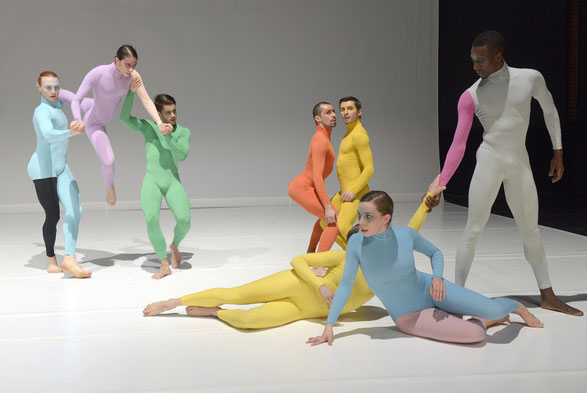
This is because her work has an aesthetic dimension (an acknowledged influence from Daniel Richter). The artists wear light, fruity-colored suits, and later hoods in the same tones; physical differences between men and women fade—here too, it is the group that takes shape, forming and separating, staying or leaving.
The ensemble, however, remains somewhat classical, as one being (Louiza Avraam) appears to command the limbs of the group, which respond to the sound of a powerful organ (Martin Mitterstieler).
Anna Konjetzky rejects narration; Liliana Barros partially embraces it. These two perspectives make the choreographies two facets of a socio-aesthetic analysis of a world in turmoil. This is far from art for art’s sake, and it is a true liberation!
Dominique-Marie van de Kerckhove
28.03.17
http://jeudi.lu/le-groupe-plutot-que-lindividu-konjetzky-_barros-choregraphie-nouvelle-a-sarrebruck/
SAARBRÜCKEN
Of Attraction and Repulsion
On Saturday, a two-part ballet evening will premiere in Saarbrücken: featuring a choreography by State Theater dancer Liliana Barros and a piece by Munich choreographer Anna Konjetzky.
Those who prefer to speak with the body sometimes find it difficult to find the right words for their own choreographic work. And so, in conversation, Anna Konjetzky and Liliana Barros initially wrestle with the appropriate expressions for their abstract-contemporary dance pieces, which they will present on Saturday in Saarbrücken.
Barros calls her choreography “My Name is Legion,” with which she aims to present a calling card for a future career as a choreographer. At the end of the season, the audience favorite will leave the Saarbrücken Ballet after ten years (with a brief interruption) to work independently as a dancer. Most importantly, however, she wants to expand her choreographic work, which has already impressed audiences at many “SubsTanz” evenings in Saarbrücken.
“My name is Legion, for we are many” is a quotation from the Gospel of Mark. When asked by Jesus who he is, the man possessed by a demon answers this way. Legion, therefore, is the name of a demon that appears in many forms.
The Greek word “legion” means a number, a multitude—and is, of course, also a military term. “You can have many associations with this title,” says Barros. In her piece, she explores questions of group dynamics: How does the individual move and behave within and in relation to the group? Which instincts or demons guide a person? Does one move like an animal in the herd? Like a soldier in a unit? Where does it drive them, where is their place? What does migration mean? “The eight dancers will interact extensively, as a group, as a tangle of humans,” says Barros.
Another source of inspiration: the most recent works by Daniel Richter, which deeply moved Barros in his 2016 Frankfurt exhibition. In these very minimal works, the focus lies on the body and physicality. Body parts and facial features are interwoven collage-like, radiating enormous tension. “You associate untamed sexuality; you see attraction and repulsion simultaneously,” says Barros. At the same time, Richter’s abstract, interlaced body contours can also be read as a kind of map: where do boundaries lie? Barros interprets her theme through electronic music.
As with Liliana Barros’ work, the focus is on questions of coexistence and interaction, rather than the inner lives of individuals.
photo credit: Bettina Stoess
SAARBRÜCKEN
Great Emotions, Deep Thoughts
von Esther Brenner, 28. Juni 2016

photo credit: Bettina
Stoess
(...) Overall, it was Liliana Barros’s evening, who stood out as a multi-talented artist from the otherwise excellent ensemble. It culminated in her piece “Collider/Vainglory”, simultaneously the highlight and the finale of the long ballet evening. Six dancers in golden costumes move mechanically across the stage to pulsating beats. They appear as androgynous beings in a trance.
Barros, who has already presented several successful choreographies in recent years, develops here a multilayered dance work in which pairs periodically break off for pas de deux, while the dancers otherwise largely act in isolation. One associates a runway—more appearance than substance, glitter and glamour. The choreographer places great emphasis on the dancers’ facial expressions: there is nothing to laugh at; everything appears artificial, affected, dehumanized. In the end, the ensemble freezes under a shower of gold.
With this promising choreography, Liliana Barros positions herself for the coming season: she has been commissioned to create a piece for a multi-part evening. (...)
https://www.pressreader.com/germany/saarbruecker-zeitung/20160628/281900182516315
SAARBRÜCKEN
Dance, or: Let Yourself Be Surprised
von Cathrin Elss-Seringhaus, 14. Juni 2010

(...) And the strongest, most mature contribution? That was delivered by Liliana Barros with “CLARITAS.” Indeed, it is a “pleasant” piece, an easily accessible short fairy tale in the vein of “Beauty and the Beast” set in an exquisite Rococo backdrop. Here, a vain, attractive light figure (Melanie Schaffer) meets her animalistic, awkward counterpart (Meritxell A. Molinero). Both appear in visually captivating corsets and tutus—two mythical beings united in rivalry. One can reflect on the mirror and twin motifs as well as aesthetic theories: art has the power to make ugly things appear beautiful—and vice versa. This confection marked the opening of the entertaining five-part evening. (...)